
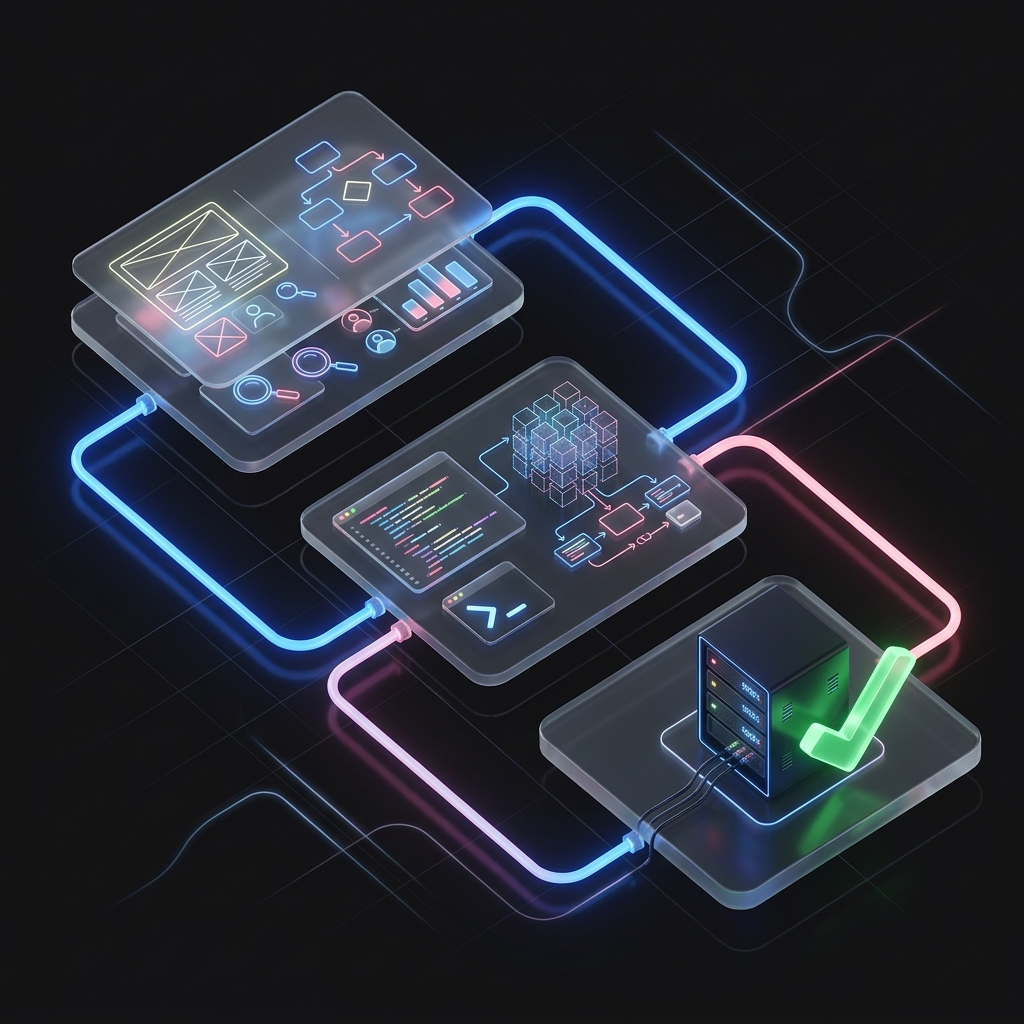
The kind of work we take on
Operations platforms that replace the spreadsheets
Consolidating the workflows your team has been running by hand — across sites, departments, suppliers — into one integrated system. Integrated with the ERP, CRM, accounting platform, or warehouse system you're already paying for. Built so the operators who'll live with it actually want to use it on a Tuesday morning.
AI features inside the products you already run
One feature, six weeks, real evals, real observability. Search, support, classification, generation — picked because it earns its keep, not because there's a TAB called AI. We'll tell you which features shouldn't be built; we'll ship the ones that should.
Modernisation, in bounded phases
Untangle a monolith. Extract a service. Replace a brittle module. Prepare a data layer for AI. Eight to twelve weeks per phase, bounded scope, bounded budget — no eighteen-month rewrites in disguise.
Operations platforms that replace the spreadsheets
Consolidating the workflows your team has been running by hand — across sites, departments, suppliers — into one integrated system. Integrated with the ERP, CRM, accounting platform, or warehouse system you're already paying for. Built so the operators who'll live with it actually want to use it on a Tuesday morning.
AI features inside the products you already run
One feature, six weeks, real evals, real observability. Search, support, classification, generation — picked because it earns its keep, not because there's a TAB called AI. We'll tell you which features shouldn't be built; we'll ship the ones that should.
Modernisation, in bounded phases
Untangle a monolith. Extract a service. Replace a brittle module. Prepare a data layer for AI. Eight to twelve weeks per phase, bounded scope, bounded budget — no eighteen-month rewrites in disguise.
Built for the way your business actually runs
We start with your operators, not your stack
The people who'll live with the software every day are the ones we talk to first — not only the CIO procuring it.
Most of what we build looks the way it does because we sat with the operations team, the warehouse manager, or the support lead and watched how they actually work. Software that gets used is software shaped to the work, not the org chart.
We start with your operators, not your stack
We learn your existing stack before we touch it
Every established business runs on a stack that took years to settle — off-the-shelf tools, internal systems, and the spreadsheet that's somehow load-bearing.
We map it before we propose anything. Integrate cleanly with the parts that work, replace only what's genuinely blocking the business, and never sell you a rebuild that's bigger than the problem.
We learn your existing stack before we touch it
We scope for change, not just for code
New software fails at the point of adoption more often than at the point of delivery.
Every engagement includes a rollout plan — pilot users, feedback loop, training material, observability for who's actually using what. We design for the Tuesday morning after launch, not just the Friday demo before it.
We scope for change, not just for code
One team, one contract, one number to call when it's wrong
No subcontractor chain.
No "delivery partner" handoffs. No three-vendor escalation when something breaks. Two-to-six engineers and designers, one engagement lead, one written-down scope. The size is the point — small enough that nobody can pass the buck.
One team, one contract, one number to call when it's wrong
We start with your operators, not your stack
The people who'll live with the software every day are the ones we talk to first — not only the CIO procuring it.
Most of what we build looks the way it does because we sat with the operations team, the warehouse manager, or the support lead and watched how they actually work. Software that gets used is software shaped to the work, not the org chart.
We start with your operators, not your stack
We learn your existing stack before we touch it
Every established business runs on a stack that took years to settle — off-the-shelf tools, internal systems, and the spreadsheet that's somehow load-bearing.
We map it before we propose anything. Integrate cleanly with the parts that work, replace only what's genuinely blocking the business, and never sell you a rebuild that's bigger than the problem.
We learn your existing stack before we touch it
We scope for change, not just for code
New software fails at the point of adoption more often than at the point of delivery.
Every engagement includes a rollout plan — pilot users, feedback loop, training material, observability for who's actually using what. We design for the Tuesday morning after launch, not just the Friday demo before it.
We scope for change, not just for code
One team, one contract, one number to call when it's wrong
No subcontractor chain.
No "delivery partner" handoffs. No three-vendor escalation when something breaks. Two-to-six engineers and designers, one engagement lead, one written-down scope. The size is the point — small enough that nobody can pass the buck.
One team, one contract, one number to call when it's wrong
Questions an operations director usually asks
Bring us the problem that's slowing your team down.
Not a polished spec. A real problem — the spreadsheet that's load-bearing, the AI feature you've been told you need, the platform you've outgrown. We'll leave you with a one-page memo on how we'd approach it.